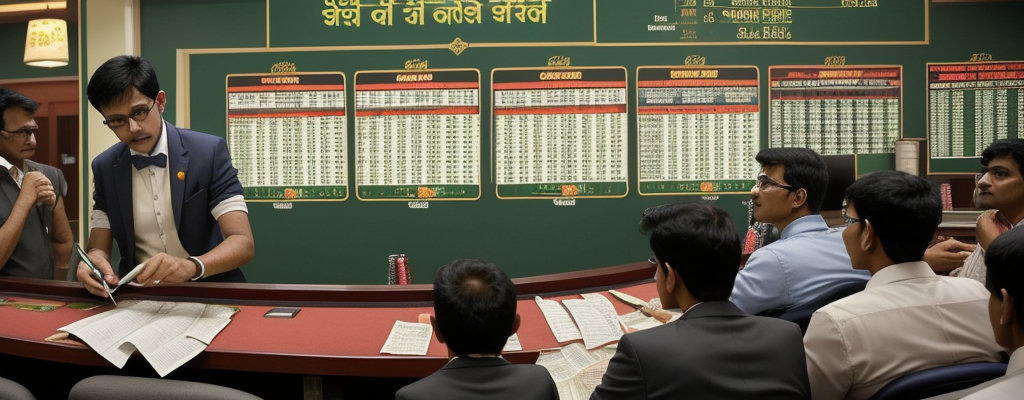
Betting odds do two jobs at once: they show the implied chance of an outcome, and they set what you win if it lands. That is the whole answer to how to read betting odds. Three formats cover almost everything you will see — decimal (2.00), fractional (5/2, Evens) and American or moneyline (+150, −200). Decimal is the default on most India-facing betting sites, including Leon Casino, so treat it as your home base and convert everything else into it. One point matters more than any formula: odds are the price a bookmaker offers, not a prediction of the result.
What Are Betting Odds? The Short Answer
Odds are a price. When you see 2.50 next to an IPL team, that number tells you how much a winning bet returns and, in reverse, roughly how likely the bookmaker thinks that outcome is. A short price (1.50) means a likely outcome with a small payout. A long price (10.00) means an unlikely outcome with a big payout. Neither is a forecast you can bank on.
Three formats do the same job in different notation:
- Decimal — 1.50, 2.00, 3.75. Standard across India-facing sites.
- Fractional — 1/2, Evens, 5/2. Still used on UK and Irish racing markets.
- American (moneyline) — +150, −200. Common on US screenshots and stats pages.
Reading any price follows the same four steps:
- Identify the format. Is it 2.00, 2/1 or +100?
- Convert to decimal if it is not already.
- Turn the decimal price into implied probability so you can judge the chance.
- Multiply your stake by the decimal price to get the total return.
Once you can run those four steps without thinking, no screen on any site can confuse you. If you are new to the mechanics of staking and markets, the how to bet guide walks through the process end to end.
Decimal Odds: The Format You Will See Most in India
Decimal odds are the simplest of the three because they already include your stake in the number. A decimal price of 2.00 doubles your money. A price of 1.50 returns half your stake as profit. A price of 10.00 returns ten times your stake.
Two formulas cover everything:
- Total return = stake × decimal odds
- Profit = total return − stake
So ₹100 at odds of 3.00 returns ₹300 in total and profits ₹200. ₹100 at 1.50 returns ₹150 and profits ₹50. The stake is never subtracted from the quoted number; it is baked in.
The other half of the picture is that shorter decimal odds mean a higher implied chance. A 1.50 price suggests a much more likely outcome than a 5.00 price, which is exactly why it pays less. The table below shows both sides of the same number on a ₹100 stake.
Decimal odds: return and implied probability on a ₹100 stake
| Decimal odds | Implied probability | Total return on ₹100 | Profit on ₹100 |
|---|---|---|---|
| 1.50 | 66.7% | ₹150 | ₹50 |
| 2.00 | 50.0% | ₹200 | ₹100 |
| 2.50 | 40.0% | ₹250 | ₹150 |
| 3.00 | 33.3% | ₹300 | ₹200 |
| 4.00 | 25.0% | ₹400 | ₹300 |
| 5.00 | 20.0% | ₹500 | ₹400 |
| 10.00 | 10.0% | ₹1,000 | ₹900 |
Notice how the profit column climbs faster than the probability column falls. That is the trade-off at the heart of every bet: longer odds pay more because they land less often.
Fractional Odds: Reading 5/2 and 11/10
Fractional odds show profit relative to the stake, not total return. That single difference is where most readers slip up. A price of 5/2 means a ₹200 profit on a ₹100 stake — you get your ₹100 back on top, so the total return is ₹300.
Converting fractional to decimal is one step:
(numerator ÷ denominator) + 1
For 5/2 that is (5 ÷ 2) + 1 = 3.50. For Evens (1/1) it is (1 ÷ 1) + 1 = 2.00. For 11/10 it is (11 ÷ 10) + 1 = 2.10.
This format still shows up on horse racing markets such as the Indian Derby, and on UK meetings like Royal Ascot that Indian punters follow. If you are comparing a 5/2 on one screen with a 3.50 on another, they are the same price — the confusion is only in the notation.
Fractional odds converted to decimal and implied probability
| Fractional odds | Decimal equivalent | Implied probability | What it means |
|---|---|---|---|
| 1/2 | 1.50 | 66.7% | Heavy favourite |
| Evens (1/1) | 2.00 | 50.0% | Coin-flip |
| 6/4 | 2.50 | 40.0% | Strong favourite |
| 2/1 | 3.00 | 33.3% | Solid favourite |
| 11/4 | 3.75 | 26.7% | Mid-priced outsider |
| 5/1 | 6.00 | 16.7% | Outsider |
| 10/1 | 11.00 | 9.1% | Long shot |
If you only remember one thing from this section, remember that fractional prices quote profit and decimal prices quote the full return.
American Odds (Moneyline): What +150 and −200 Mean
American odds are built around a $100 reference point, which is why they look odd on an Indian screen. The sign carries the meaning.
A plus sign marks the underdog and shows the profit on a $100 stake. So +150 means a $100 bet profits $150, giving a $250 total return.
A minus sign marks the favourite and shows the stake needed to win $100. So −200 means you must stake $200 to win $100, which is a $300 total return.
Both convert to decimal cleanly:
- Positive odds: (American ÷ 100) + 1. So +150 becomes (150 ÷ 100) + 1 = 2.50.
- Negative odds: (100 ÷ the number after the minus, ignoring the sign) + 1. So −200 becomes (100 ÷ 200) + 1 = 1.50.
American (moneyline) odds converted to decimal
| American odds | Decimal equivalent | Stake needed to win $100 | Favourite or underdog |
|---|---|---|---|
| +100 | 2.00 | $100 | Pick'em |
| +150 | 2.50 | $100 | Underdog |
| +200 | 3.00 | $100 | Underdog |
| +500 | 6.00 | $100 | Long shot |
| −110 | 1.91 | $110 | Favourite |
| −150 | 1.67 | $150 | Favourite |
| −200 | 1.50 | $200 | Heavy favourite |
Moneyline odds appear often when Indian bettors read US-facing cricket coverage or stats pages, so the conversion is worth knowing even if you never bet in that format.
Implied Probability and the Bookmaker's Margin
Implied probability converts any price into a percentage chance. The formula is:
Implied probability = 1 ÷ decimal odds × 100
At 2.00 that is 1 ÷ 2 × 100 = 50%. At 1.50 it is 66.7%. At 4.00 it is 25%. You can run this on your phone in a second, and it is the single most useful habit on this page.
Now add up the implied probabilities of every outcome in a market. In a perfect world they would total exactly 100%. In practice they always total more. That excess is the bookmaker's margin, also called the overround or the vig.
A two-way market priced at 1.91 and 1.91 makes the maths easy to see. Each side carries an implied probability of roughly 52.4%, so the market totals about 104.7% — a margin of roughly 4.7%. The bookmaker keeps that slice across the book regardless of who wins.
Why does this matter to you? Because a smaller margin means better long-run value. If the same cricket market is priced at 104% on one site and 108% on another, the first site is giving you more for the same risk. That is why comparing the margin, not just the headline price, is worth the extra ten seconds.
Why Odds Move — and How Indian Sports Markets Differ
A price rarely stays still. Odds shorten when money comes in on one side, or when team news breaks — a late injury, a change to the playing eleven, a pitch report. As more money lands on an outcome, bookmakers shorten its price to protect themselves.
Live, or in-play, odds move even faster. In cricket they shift ball by ball. In kabaddi they move raid by raid. In football they move with every attack and every over in the equivalent limited-overs formats. Because the game state changes constantly, live pricing is a running calculation rather than a fixed number.
Market depth varies by sport in India:
- Cricket, and the IPL in particular, carries the deepest markets in the country. More liquidity means tighter margins and more markets per match.
- Pro Kabaddi League draws a smaller but genuine following with its own live markets.
- Indian horse racing classics such as the Indian Derby attract serious racing money, though the number of meetings is limited.
One practical quirk: markets are frequently suspended when a wicket, a goal, a raid or the toss changes the game state. Suspensions are not errors — they are the bookmaker pausing pricing until the new picture is clear. If you are still learning how markets are structured per sport, the cricket betting hub sets out the main market types. And if you are ready to move from reading odds to staking, how to place a bet on cricket covers the sequence.
Worked Example: Reading an IPL Match-Winner Market
Here is every concept applied to one example. These are illustrative figures, not live or operator-specific odds.
Take a two-way IPL match-winner market priced at 1.80 on Team A and 2.05 on Team B.
Implied probability:
- Team A at 1.80: 1 ÷ 1.80 × 100 = 55.6%
- Team B at 2.05: 1 ÷ 2.05 × 100 = 48.8%
Add them together: 55.6% + 48.8% = 104.4%. That extra 4.4% is the bookmaker's margin on this market.
Return on a ₹500 stake:
- Team A at 1.80: ₹500 × 1.80 = ₹900 total return, a profit of ₹400.
- Team B at 2.05: ₹500 × 2.05 = ₹1,025 total return, a profit of ₹525.
So the underdog pays ₹125 more on the same ₹500 stake, because the market rates that outcome as less likely. That is the entire relationship between price, probability and payout in one line.
One last thing: re-check the price after the toss, because it will have moved. A toss that hands one side first use of a fresh pitch can swing a match-winner market noticeably in a matter of minutes.
Common Odds-Reading Mistakes to Avoid
Most costly odds errors are not mathematical, they are interpretive. The checklist below covers the ones that come up again and again:
- Comparing a fractional price with a decimal price without converting first. 5/2 and 3.50 are identical — always convert before you judge which is better.
- Confusing total return with profit. A 2.00 decimal price means double your stake returned, not a 200% profit.
- Ignoring the margin when comparing the same market on two sites. A marginally better headline price on one market can sit inside a much wider overround overall.
- Forgetting that a short price still loses more often than it wins. At 1.50 the implied chance is 66.7%, which means roughly one loss in three over the long run. Short prices are not safe prices.
- Not checking dead-heat and void-bet rules in horse racing markets. These rules decide what happens to your stake when a race produces a tie or an outcome is declared void, and they vary by bookmaker and market.
- Treating odds as a forecast. They are a price, and prices are wrong all the time.
If you are weighing up a sign-up offer before your first bet, check what the current bonus terms actually require — terms and conditions apply, and wagering conditions decide whether a bonus is worth taking.
Odds describe probability, not certainty. No price, however short, is a guaranteed outcome, and no staking pattern removes the possibility of a loss. 18+ only. Set a budget before you bet, never stake money you cannot afford to lose, and use the deposit and withdrawal limits and self-exclusion tools on the site if betting stops being entertainment. If betting stops feeling like a choice, stop and seek support.